Wednesday, March 5, 2014

Ukraine/Crimea Strategic Thoughts


The Russian takeover of Crimea is perhaps the most interesting thing to occur in my lifetime; so I feel I should write about it. I'm reasonably good at predicting various things so I suppose I should highlight the outcomes and potentialities of this conflict. Firstly the Russian action is an extremely well timed maneuver. While lethargy on the part of the militaries of the various Western nations is ultimately going to get worse and worse the less wars are fought (not to say wars are a good thing, but they might as well be inevitable), the global economic troubles are somewhat unique so reliance on Russian natural resources is much higher than it might be in a few years. Doing it immediately after the close of the Winter Olympics is also quite smart because those events are ostensibly about peace-time activities; and the Ukrainian athletes at the event were not to my knowledge treated poorly in any respect.

So, what can the West do about it and what is at stake here? Well, Crimea and the Ukraine as a whole are a very bloodied area historically, while fighting over the Crimea has happened on numerous occasions Ukraine itself is just in this sandwich area between Western and Eastern Europe that has been the stage of numerous military campaigns. The Crimea is ridiculously valuable as a naval bastion, it is the best Russia can hope for in terms of naval basing in the Black Sea and as a greater outlet to the Mediterranean, Atlantic, and Indian Oceans. Russia gaining this territory, whether as a satellite independent nation or as an unlikely annexation is quite useful for them, strategically and economically.

The natural and over-used comparison here is Hitler's invasion of the Sudetenland, Czechoslovakia, and Austria; the situation is not inherently comparable except for the justification of the war goal (i.e. protection of Ethnic Russians). What Russia being successful does is derail the "peaceful Western world" theory, that in a post nuclear weapons world we needn't fight conventional wars, which has always been an extremely, even foolishly optimistic outlook. Eventually some stronger nation is going to realize that it can become even stronger through military action and is unlikely to expand purely on the basis of trade. Essentially China has no real reason for military restraint in any situation if Russia wins this war without firing a shot; and while China is inevitably the most powerful country in the future it could become a veritable titan encompassing 1/3rd of the world's population instead of just 1/5th or so.

What can the West do about it? Well, basically in the next 48-72 hours the US and NATO have to send a sizable force to Ukraine and sit on the Crimean/Ukranian border under strict orders to not provoke the enemy. As long as they stay there there's a decent chance the Russians back down a la the Cuban Missile Crisis. Sending NATO troops to Kiev is not enough; because Russia is not really all that interested in Kiev to begin with.

A military conflict arising here might serve as a deterrent to other powerful nations but probably wouldn't stop Russia in this case. While the US could theoretically beat Russia in a land war it would take an extraordinary toll on our military forces and probably require a draft et cetera. This would probably fuel our economy back up to an impressive status since people would have to work a whole bunch for the sake of the war machine; but it doesn't matter because the vast majority of the United States' citizens are not even slightly interested in a war, particularly not one where tens of thousands of Americans would die. Russia's army is almost certainly more prepared for this sort of conflict at this point in time, while we obviously have technological advantages we don't have unified morale under a strong leader and we don't have all that many combat-ready troops. Our special forces can go toe to toe with the Russians but we just don't have enough of them, and the sequester sure as hell isn't helping.

I don't really have a stake in this war to be blunt, but I think the most likely result at this point is that the Russians just sit on Crimea until we allow them to grant the nation independence. This country would serve as a puppet state more or less but might eventually be a perfectly normal country in Eastern Europe; the Crimean Tatars were in possession of the land hundreds of years ago and them reforming that nation is not a particularly abhorrent action. It just depends what the US and the EU do; they can't really offer serious military resistance but they can put non Ukrainian troops in a dangerous situation and see what the Russians decide to do; if the Russians open fire first then that might propel various nations to send a more sizable force; at which point a larger conflict would begin. Ultimately economic sanctions that don't include China aren't going to be enough to stop the Russians or Putin; and it doesn't seem like there's any way China imposes those sanctions. However they could well be the swing power in this situation that I haven't heard many people highlight up to this point.

I may well write more on this in the future as it develops; but aside from that 5 days to Dark Souls 2, hopefully the world doesn't end before then.

Sunday, March 2, 2014

Great Captains - Frederick the Great


Ah Frederick, he and Fred Bear have contributed to my nomenclature. Frederick basically held his own against various much larger foreign powers over the course of 2 major wars and managed to expand Prussia both nominally and on a prestigious level. His efforts basically set the precedent for the eventual formation of Germany under the Iron Chancellor. The Prussian military was trained to great effect by his father and thus Frederick II had a decent base to work from (similar to Alexander in that regard). Like Alexander he won because he found a distinctive flaw in the opposition's strategy and exploited it numerous times.

Essentially all of Frederick's major battles after the first were won via outflanking the opposition, most famously at Leuthen but perhaps most impressively at Rossbach. At Leuthen Frederick advanced under cover of fog and hills to a position on the opponent's flank and successfully attacked and destroyed a numerically superior enemy successfully; solidifying his country's hold on Silesia (the primary objective of all of his wars) in the process. This is usually the battle held up by historians as his finest effort, and in terms of diplomatic effect and decisiveness it was certainly the most important, but I find the battle of Rossbach to be entirely too fascinating to elevate Leuthen in its place.


In an utterly brilliant maneuver Frederick abandoned his position on the eve of battle and lured the enemy into a foolish pursuit, then surrounded and destroyed the opposition. It's the sort of thing you'd read about in Three Kingdoms, a novel based on history but prone to stretching certain facts. Basically the opposition assumed Frederick was retreating because of their overwhelming numerical superiority; but Frederick used this to his own advantage and successfully exploited it. This sort of maneuver requires an exceptional amount of courage on the part of the commander and on the part of his troops.

Said troops were perhaps some of the finest in the history of the world; as they fought time and again against larger enemy forces and won almost every battle. Faith in their exceptional leader and reliance on their extensive training won out, more often than not. Frederick was not a leader of a great world power when he began, but he most certainly had turned Prussia into one by the end of his reign. In the Seven Years' War he defeated France, Russia, and Austria; a coalition more than 10 times his size. Britain was an ally in the war (which is known in the US as the French and Indian War, and for George Washington's befuddled participation), but he basically did all of the fighting and funding/supporting of his men; and somehow miraculously won. That is the strength of a great commander, the capacity to succeed when there is no logical chance for success.

Addendum: I guess there's some vague chance that someone from Ukraine will read this so I'll add an additional commentary here. What can this information be used for practically you ask? Well it's important to understand that no matter how dominant the opposition is they will usually have quite a few characteristic weaknesses for you to exploit, it is only up to you to find out what they are and to correctly anticipate their actions because of said weaknesses. With such information and the audacity to execute wideranging ambushes or flanking maneuvers (admittedly more difficult in the age of satellite observation) one can defeat a nominally superior opponent.

Friday, February 28, 2014

Non-Stop


Non Stop is brilliant. There's not really any other way to put it; the incredible power of Liam Neeson early in the year continues and this is the best one yet. This is one of the best suspense films ever created and almost certainly the best one involving a plane. The usual issue with a suspense film of this nature is that the plot is revealed too early or is too obvious; while you might be able to figure out parts of the final setup figuring out the entire thing is rather unlikely and it doesn't show its hand until the final 20 minutes.

The previews simultaneously show a lot from the film without really revealing much about it. The basic plot is that Liam Neeson is on a plane and needs to protect it from a potential hi-jacker who vows to kill someone every 20 minutes. I can't really say a ton more than that without spoiling parts of the plot, but suffice to say that the film handles essentially every component quite well. There is a veritable sea of red herrings in this movie and that just adds to the suspense; though you might correctly guess that everyone on the plane can't be a red herring.

Despite ample opportunities to do so the film never gets cheesy either; there's no easy thing to point out that's obviously wrong or silly about the movie; like wading through water in sub freezing temperatures in The Grey, or January Jones in Unknown, or the weird primary sub plot in Taken. The film just doesn't have any major flaws to speak of. Now, it doesn't have any tremendous monologues or things to put it on par with something like the Silence of the Lambs but I am quite comfortable saying this is easily going to wind up being a top 10 film for 2014.

Shea Whigham is in this movie, because he's been in like every good movie (and True Detective) in the past 12 months (either him or Paul Dano); and he's great... again. This is that guy from Bad Lieutenant... whoa. I mean he is certainly a talented actor it's just awesome to see him getting a lot of work/recognition. Something else this film does just perfectly is the casting, every damn person looks shady for some reason or another and there's always a shot of them looking so, except for one notable exception. The film has exemplary pacing, casting, acting, and even knows when it's getting close to being cheesy but throws in dialogue to eliminate that immediately. A damn good film.


Thursday, February 13, 2014

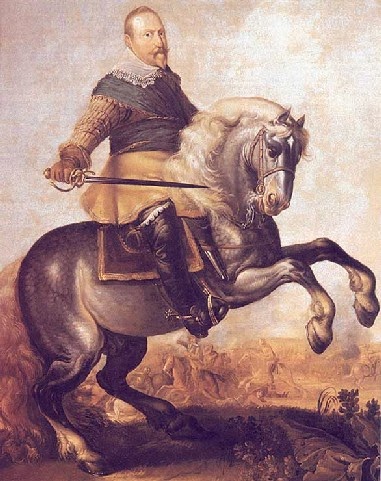
Great Captains - Gustavus Adolphus


Gustaf Adolf II was King of Sweden from 1594-1632 and he was naturally a major player in the Thirty Years War of that time period. His reign is seen as a sterling example of how to "modernize" and greatly improve the efficiency of one's military in a short time period. In terms of training and strategic competence he is one of the foremost military leaders in history. Training is a very difficult thing to grasp, whether strict methodology and rigorous drills are the best method or more flexible procedures. The Non-Orthodox (loosely translated as "Guerilla," though any non traditional troop falls into this category) vs. Orthodox paradigm essentially; an ideal military utilizes both types of troops to their advantage. Hannibal is perhaps the foremost at integrating vastly different troop types into a seamless whole; but Gustavus may have been the best at simply training exceptional Orthodox troops (which dominated much of Europe for the next two centuries).

Gustavus is recognized by the vast majority of military historians as a commander on par with Napoleon (who also recognized him as such) or Frederick the Great; but his campaigns show no great tactical competence, though he definitely demonstrates the other elements of being a "Great Captain." The general consensus is that he died too young (in battle, at Breitenfeld) and in the midst of his zenith campaign. Sweden was certainly the most prosperous during his rule and retained much of its power for several generations thereafter; so his capabilities as a ruler are unquestioned. But typically you'd want someone who had demonstrated tactical acuity in addition to strategic and marshaling competence; ultimately it is not for me to say as he did die young.

So, what things can be learned from Gustavus? The most important thing is that what you start out with does not matter, you can have a mediocre military framework or even a particularly bad one and can still innovate and improve upon both your internal military strength and your external military reputation worldwide. Once power over the military is attained a truly competent leader can reform and refit his men into the finest fighting force in the entire world. His system was largely merit based, one's family did not play a role in his ability to be promoted and thus the military blossomed as they were aptly rewarded for competence. This is a fairly early example of such a process; and even most of today's militaries don't follow this procedure; nepotism is perhaps the first sign of decay in any organization and having a truly merit based system is the antithesis of that.

Still, Gustavus' lack of any exceptional battle to look back upon is worrisome and it is difficult to teach precisely what lessons you could learn from his administration. To be sure he had fairly competent leaders against him in both Tilly and Wallenstein, but neither had the sheer initiative that Gustavus had and I feel in time he could have summarily dismantled parts of the Holy Roman Empire. The Protestant faith itself would not be what it is today without Gustavus Adolphus protecting it, and this is perhaps why Dodge specifically recognized him. His pre-eminence was also the consensus of the thought period and may even be in the historical consciousness today (though said consciousness is quite static and in need of reform).

Thursday, February 6, 2014

What drives change?


Competence is a valued thing in rare situations throughout human history. For the rest of time it is desired that the worker or the "normal" person retain just the adequate degree of averageness. To not have this trait is an aberration, a horrifying prospect. The most average of men is the man of predominance; "The average man's average man" was a slogan describing American president Warren G. Harding. The same slogan could easily describe George W. Bush or Jimmy Carter or Gerald Ford; it is an asset to not possess any particularly extraordinary traits. Napoleon said "in Politics, stupidity is not a handicap;" well the same is true for every position in society whilst society decays. What causes they decay one might ask? Well unrivaled amounts of human incompetence of course; the promotion of mediocrity, the lack of pursuit of intellect. Usually it takes countries hundreds of years to fall from excellent heights, but this one perhaps only 70 or so; such is the remarkable nature of our incompetence.

Incompetence drives men to do incredible things, revolutions all derive from this universal source. A man can only be motivated by the pure unbridled stupidity of one's fellow man. Similarly incredible acts of horrifying violence exist solely because of incompetence; to know and understand this is to begin understanding human nature. The first King is magnificent in his splendor, the second King a worthy heir and only slightly less magnificent, the third King a fool, the fourth King, an average man, the fifth King a tyrant. But perhaps not a Tyrant by nature, but only by situation. Maybe the fifth King is a just and able ruler forced into a terrible situation given to him by his forebears. Maybe he actually is incompetent, maybe he is simply average. But he is most certainly a tyrant in the eyes of history. Such is the pattern throughout history, such is the pattern now.

Thursday, January 23, 2014

Aristotle Quote


No, not that Aristotle. A tidbit of wisdom from the Metaphysics, again translated by Hippocrates G. Apostle:

"We must also inquire in which of two ways the nature of the whole has the good and the highest good, whether as something separate and by itself, or as the order of its parts. Or does it have it in both ways, as in the case of an army? For in an army goodness exists both in the order and in the general, and rather in the general; for it is not because of the order that he exists, but the order exists because of him." (p. 210)

While this is somewhat unrelated to his general point Aristotle distributes uncommon wisdom with this realization. In the modern age where there hasn't been a "great mover" (as Aristotle might say) in almost 200 years you run into this situation where command exists because command exists; the authority does little to establish or justify his existence and thus generates dissent and ineffectuality amongst the men. Order without purpose is not useful nor productive in generating an efficient fighting machine. Thus with no agent to shake things up the present system decays into a lethargic state, ripe for exploitation and destruction at the hands of a more skilled, disciplined, and indeed "ordered" opponent.

Monday, January 13, 2014

Great Captains - Caesar


Caesar is perhaps the only person in the history of mankind to embody both the role of Great Commander while also being a "Sage" or person of great diplomatic influence. Sages are a sort of debatable set but you can get the idea of who they might be (Martin Luther King, Gandhi, Jesus, Homer, perhaps even Hitler based on oratory skill alone*), Caesar was certainly one of the foremost public speakers of his day and obviously by far the most influential. His military conduct is very interesting, as he certainly performs with exceptional skill but in some respects also acts recklessly in certain situations (though one could say Alexander acted recklessly in all situations with regard to his own personal safety).

* For Kongming it becomes a matter of debate, his historical merit on the political front is unquestionable but his merit as a general is exceptional to be sure but not necessarily transcendent; even his direct peers seem to be somewhat superior.

Dodge begins by discussing his campaigns in Gaul; Caesar, despite no such order from the Senate, decided to conquer the rest of modern day France and the "barbarian" tribes therein; but such tribes were actually fairly well organized and militarily capable; they might not have had the quality of the Roman Legions but they were a respectable fighting force with reasonably competent commanders in charge. Caesar at this point was largely unproven as a military commander, despite being at the ripe old age of 42 (ancient for a Western commander, though not all that old for an Eastern one or even Saladin or Salah al-Din if you prefer), being that he was primarily a diplomat up to that point in his life. But he still had that certain knack and incredible intellectual ability to be able to embrace this new, perhaps highest of arts.

He began by countering a flanking maneuver with a flank of his own; I suppose a prelude to his later actions. Dodge's criticism of Caesar is that he was too prone to maneuver, though this ultimately makes no sense because maneuver is the most difficult and most rewarding aspect of warfare. The most impressive victories are those that come with no bloodshed; one of Napoleon's proudest moments was his total outflank and capture of the Austrian army at Ulm; scarcely firing a single gun in the process of capturing 30,000 men. Additionally quite a few battles are decided by the maneuvers before the battle begins; they don't have the formation brilliance of something like Cannae necessarily but they have the maneuver phase of an ascendant nature. The outflank at Leuthen, the absolutely masterful maneuver at Rossbach, the forcing of the battle of Borodino, the contested crossing at Wagram, Kongming's campaigns in Shu, the battle of Chancellorsville, the number of battles where maneuver determined the result is staggering. Thus, maneuver is paramount and one can not maneuver "too much" unless one does not value the life of his men.

Of course Caesar also had the dubious reputation for slaughtering hundreds of thousands of helpless Gaul "Barbarian" civilians, which amongst Dodge's list of Great Captains is certainly unique and not exactly respectable. From a military aspect there can be value in both being cruel and being fair and kind, Caesar I suppose tried to be both and it is hard to argue with his results though the means are unjustifiably inhumane. There's always some lingering question as to whether the cruelest or the most righteous man would win in a contest of equal wits and standing; but there is no clear-cut answer. Personally I would aid the cause of righteousness but I can't say that I would have no doubts so doing.

Caesar's most remarkable feat was the siege of Alesia, shown above. Sieges are not a particularly interesting element of warfare for most of the time they are simply matters of pure attrition; however numerous examples from Chinese history and a handful from Western history show that this need not always be the case. Alesia is perhaps the foremost example of ingenuity deciding a siege. Caesar trapped his most able opponent in a siege but was then onset by a much more numerous force from the exterior. To counter this he trapped his own men with a second larger wall on the exterior; knowing his supplies to be the superior of his opponent's. So doing he managed to defeat Vercingetorix and pacify Gaul, for the time being. Alexander's Siege of Tyre may be more ridiculous and unbelievable (though the remnants of his earthen bridge remain to this day) but in terms of intellectual calculation there is no finer example of how to hold a siege in Western history.