Friday, February 28, 2014

Non-Stop


Non Stop is brilliant. There's not really any other way to put it; the incredible power of Liam Neeson early in the year continues and this is the best one yet. This is one of the best suspense films ever created and almost certainly the best one involving a plane. The usual issue with a suspense film of this nature is that the plot is revealed too early or is too obvious; while you might be able to figure out parts of the final setup figuring out the entire thing is rather unlikely and it doesn't show its hand until the final 20 minutes.

The previews simultaneously show a lot from the film without really revealing much about it. The basic plot is that Liam Neeson is on a plane and needs to protect it from a potential hi-jacker who vows to kill someone every 20 minutes. I can't really say a ton more than that without spoiling parts of the plot, but suffice to say that the film handles essentially every component quite well. There is a veritable sea of red herrings in this movie and that just adds to the suspense; though you might correctly guess that everyone on the plane can't be a red herring.

Despite ample opportunities to do so the film never gets cheesy either; there's no easy thing to point out that's obviously wrong or silly about the movie; like wading through water in sub freezing temperatures in The Grey, or January Jones in Unknown, or the weird primary sub plot in Taken. The film just doesn't have any major flaws to speak of. Now, it doesn't have any tremendous monologues or things to put it on par with something like the Silence of the Lambs but I am quite comfortable saying this is easily going to wind up being a top 10 film for 2014.

Shea Whigham is in this movie, because he's been in like every good movie (and True Detective) in the past 12 months (either him or Paul Dano); and he's great... again. This is that guy from Bad Lieutenant... whoa. I mean he is certainly a talented actor it's just awesome to see him getting a lot of work/recognition. Something else this film does just perfectly is the casting, every damn person looks shady for some reason or another and there's always a shot of them looking so, except for one notable exception. The film has exemplary pacing, casting, acting, and even knows when it's getting close to being cheesy but throws in dialogue to eliminate that immediately. A damn good film.


Thursday, February 13, 2014

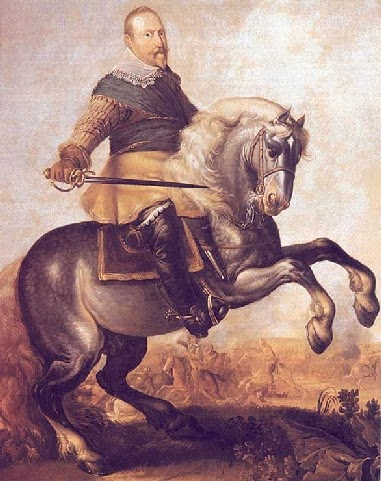
Great Captains - Gustavus Adolphus


Gustaf Adolf II was King of Sweden from 1594-1632 and he was naturally a major player in the Thirty Years War of that time period. His reign is seen as a sterling example of how to "modernize" and greatly improve the efficiency of one's military in a short time period. In terms of training and strategic competence he is one of the foremost military leaders in history. Training is a very difficult thing to grasp, whether strict methodology and rigorous drills are the best method or more flexible procedures. The Non-Orthodox (loosely translated as "Guerilla," though any non traditional troop falls into this category) vs. Orthodox paradigm essentially; an ideal military utilizes both types of troops to their advantage. Hannibal is perhaps the foremost at integrating vastly different troop types into a seamless whole; but Gustavus may have been the best at simply training exceptional Orthodox troops (which dominated much of Europe for the next two centuries).

Gustavus is recognized by the vast majority of military historians as a commander on par with Napoleon (who also recognized him as such) or Frederick the Great; but his campaigns show no great tactical competence, though he definitely demonstrates the other elements of being a "Great Captain." The general consensus is that he died too young (in battle, at Breitenfeld) and in the midst of his zenith campaign. Sweden was certainly the most prosperous during his rule and retained much of its power for several generations thereafter; so his capabilities as a ruler are unquestioned. But typically you'd want someone who had demonstrated tactical acuity in addition to strategic and marshaling competence; ultimately it is not for me to say as he did die young.

So, what things can be learned from Gustavus? The most important thing is that what you start out with does not matter, you can have a mediocre military framework or even a particularly bad one and can still innovate and improve upon both your internal military strength and your external military reputation worldwide. Once power over the military is attained a truly competent leader can reform and refit his men into the finest fighting force in the entire world. His system was largely merit based, one's family did not play a role in his ability to be promoted and thus the military blossomed as they were aptly rewarded for competence. This is a fairly early example of such a process; and even most of today's militaries don't follow this procedure; nepotism is perhaps the first sign of decay in any organization and having a truly merit based system is the antithesis of that.

Still, Gustavus' lack of any exceptional battle to look back upon is worrisome and it is difficult to teach precisely what lessons you could learn from his administration. To be sure he had fairly competent leaders against him in both Tilly and Wallenstein, but neither had the sheer initiative that Gustavus had and I feel in time he could have summarily dismantled parts of the Holy Roman Empire. The Protestant faith itself would not be what it is today without Gustavus Adolphus protecting it, and this is perhaps why Dodge specifically recognized him. His pre-eminence was also the consensus of the thought period and may even be in the historical consciousness today (though said consciousness is quite static and in need of reform).

Thursday, February 6, 2014

What drives change?


Competence is a valued thing in rare situations throughout human history. For the rest of time it is desired that the worker or the "normal" person retain just the adequate degree of averageness. To not have this trait is an aberration, a horrifying prospect. The most average of men is the man of predominance; "The average man's average man" was a slogan describing American president Warren G. Harding. The same slogan could easily describe George W. Bush or Jimmy Carter or Gerald Ford; it is an asset to not possess any particularly extraordinary traits. Napoleon said "in Politics, stupidity is not a handicap;" well the same is true for every position in society whilst society decays. What causes they decay one might ask? Well unrivaled amounts of human incompetence of course; the promotion of mediocrity, the lack of pursuit of intellect. Usually it takes countries hundreds of years to fall from excellent heights, but this one perhaps only 70 or so; such is the remarkable nature of our incompetence.

Incompetence drives men to do incredible things, revolutions all derive from this universal source. A man can only be motivated by the pure unbridled stupidity of one's fellow man. Similarly incredible acts of horrifying violence exist solely because of incompetence; to know and understand this is to begin understanding human nature. The first King is magnificent in his splendor, the second King a worthy heir and only slightly less magnificent, the third King a fool, the fourth King, an average man, the fifth King a tyrant. But perhaps not a Tyrant by nature, but only by situation. Maybe the fifth King is a just and able ruler forced into a terrible situation given to him by his forebears. Maybe he actually is incompetent, maybe he is simply average. But he is most certainly a tyrant in the eyes of history. Such is the pattern throughout history, such is the pattern now.

Thursday, January 23, 2014

Aristotle Quote


No, not that Aristotle. A tidbit of wisdom from the Metaphysics, again translated by Hippocrates G. Apostle:

"We must also inquire in which of two ways the nature of the whole has the good and the highest good, whether as something separate and by itself, or as the order of its parts. Or does it have it in both ways, as in the case of an army? For in an army goodness exists both in the order and in the general, and rather in the general; for it is not because of the order that he exists, but the order exists because of him." (p. 210)

While this is somewhat unrelated to his general point Aristotle distributes uncommon wisdom with this realization. In the modern age where there hasn't been a "great mover" (as Aristotle might say) in almost 200 years you run into this situation where command exists because command exists; the authority does little to establish or justify his existence and thus generates dissent and ineffectuality amongst the men. Order without purpose is not useful nor productive in generating an efficient fighting machine. Thus with no agent to shake things up the present system decays into a lethargic state, ripe for exploitation and destruction at the hands of a more skilled, disciplined, and indeed "ordered" opponent.

Monday, January 13, 2014

Great Captains - Caesar


Caesar is perhaps the only person in the history of mankind to embody both the role of Great Commander while also being a "Sage" or person of great diplomatic influence. Sages are a sort of debatable set but you can get the idea of who they might be (Martin Luther King, Gandhi, Jesus, Homer, perhaps even Hitler based on oratory skill alone*), Caesar was certainly one of the foremost public speakers of his day and obviously by far the most influential. His military conduct is very interesting, as he certainly performs with exceptional skill but in some respects also acts recklessly in certain situations (though one could say Alexander acted recklessly in all situations with regard to his own personal safety).

* For Kongming it becomes a matter of debate, his historical merit on the political front is unquestionable but his merit as a general is exceptional to be sure but not necessarily transcendent; even his direct peers seem to be somewhat superior.

Dodge begins by discussing his campaigns in Gaul; Caesar, despite no such order from the Senate, decided to conquer the rest of modern day France and the "barbarian" tribes therein; but such tribes were actually fairly well organized and militarily capable; they might not have had the quality of the Roman Legions but they were a respectable fighting force with reasonably competent commanders in charge. Caesar at this point was largely unproven as a military commander, despite being at the ripe old age of 42 (ancient for a Western commander, though not all that old for an Eastern one or even Saladin or Salah al-Din if you prefer), being that he was primarily a diplomat up to that point in his life. But he still had that certain knack and incredible intellectual ability to be able to embrace this new, perhaps highest of arts.

He began by countering a flanking maneuver with a flank of his own; I suppose a prelude to his later actions. Dodge's criticism of Caesar is that he was too prone to maneuver, though this ultimately makes no sense because maneuver is the most difficult and most rewarding aspect of warfare. The most impressive victories are those that come with no bloodshed; one of Napoleon's proudest moments was his total outflank and capture of the Austrian army at Ulm; scarcely firing a single gun in the process of capturing 30,000 men. Additionally quite a few battles are decided by the maneuvers before the battle begins; they don't have the formation brilliance of something like Cannae necessarily but they have the maneuver phase of an ascendant nature. The outflank at Leuthen, the absolutely masterful maneuver at Rossbach, the forcing of the battle of Borodino, the contested crossing at Wagram, Kongming's campaigns in Shu, the battle of Chancellorsville, the number of battles where maneuver determined the result is staggering. Thus, maneuver is paramount and one can not maneuver "too much" unless one does not value the life of his men.

Of course Caesar also had the dubious reputation for slaughtering hundreds of thousands of helpless Gaul "Barbarian" civilians, which amongst Dodge's list of Great Captains is certainly unique and not exactly respectable. From a military aspect there can be value in both being cruel and being fair and kind, Caesar I suppose tried to be both and it is hard to argue with his results though the means are unjustifiably inhumane. There's always some lingering question as to whether the cruelest or the most righteous man would win in a contest of equal wits and standing; but there is no clear-cut answer. Personally I would aid the cause of righteousness but I can't say that I would have no doubts so doing.

Caesar's most remarkable feat was the siege of Alesia, shown above. Sieges are not a particularly interesting element of warfare for most of the time they are simply matters of pure attrition; however numerous examples from Chinese history and a handful from Western history show that this need not always be the case. Alesia is perhaps the foremost example of ingenuity deciding a siege. Caesar trapped his most able opponent in a siege but was then onset by a much more numerous force from the exterior. To counter this he trapped his own men with a second larger wall on the exterior; knowing his supplies to be the superior of his opponent's. So doing he managed to defeat Vercingetorix and pacify Gaul, for the time being. Alexander's Siege of Tyre may be more ridiculous and unbelievable (though the remnants of his earthen bridge remain to this day) but in terms of intellectual calculation there is no finer example of how to hold a siege in Western history.

Thursday, January 9, 2014

Great Captains - Hannibal


Hannibal is a difficult topic for discussion; since his successes were so enormous but yet did not produce a successful strategic result. A sort of extremely efficient and mortifying terrorist is perhaps a decent way to describe this legendary figure. Hannibal managed to face a technologically superior foe with better troops and best him on repeated occasions. Dodge suggests that Hannibal is sort of the birth of our modern conceptions of tactics and strategy, for in teaching the Romans how to fight wars he also was teaching all future western generations.

With his first 4 major victories he showed the Romans that "there is something in the art of war beyond merely marching out to your enemy and beating him by numbers, better weapons, or greater discipline." As much as Caesar or Augustus or Octavian Rome has Hannibal to thank for its transcendence; for such grander conquests would not be possible without learning first from an utterly exceptional leader.

Perhaps the most interesting aspects of Hannibal come from modern comparisons; how would a tactically inept, well constructed, well armed force fare against an extremely competent commander in charge of a heterogeneous force? In some ways we already have our answers; in the Korean and Vietnam wars an absurdly superior force was ably defeated, albeit not without cost. Of course Hannibal's campaigns were in enemy territory, against vastly more numerous forces.

The famed Battle of Cannae is discussed at length by Dodge; as by anyone else who discusses Hannibal. It is perhaps the foremost example of a numerically inferior force winning purely on the strength of tactical ingenuity; and not only winning but completely slaughtering the opposition. The standard idea that the center "must not fall" is turned on its head in this battle where the powerful flanks decide the outcome instead of the core conflict; the battle even  utilizes the hotheadedness of the opposing commander effectively. With 30-50,000 men Hannibal completely eradicated a force of 60-80,000; the roman legions' most embarassing loss in history.

Most interesting about this battle is the composition of Hannibal's force; with soldiers from Gaul, Spain, Carthage, Nubia, and other parts of North Africa; this is perhaps the most effective truly diverse force in the history of warfare. Even going to the Eastern commanders only the Mongolian hordes have similar amounts of diversity in their eventual conquering forces; though mainly due to necessity. One wonders how World War 2 would have gone if the Germans had been able to fully utilize their Italian, Romanian, and Hungarian allies. Even Napoleon himself frequently refers to the absolute inferiority of non French soldiers; this is a very common theme throughout history where the strongest force is the most ethnocentric one; but Hannibal just completely ignored that concept and was extremely successful as a result. Such a leader's communication abilites are beyond compare; to fully utilize such a diverse force effectively is incomprehensible.

Following Cannae Hannibal was offered a choice: to attack Rome immediately or instead wait for reinforcements from Carthage /defections of the Italian supporting states. However one does not lay siege to a million strong city with a force of 35,000 so his method of attack would have had to have been quite interesting. The various wars in China frequently had to deal with the issue of besieging a fortified city, as almost every large city in China had enormous, even unnecessarily large walls. So perhaps if Hannibal had been privy to Chinese sieging methods and tactical ingenuity he may have been able to take Rome; but it is certain that with western methods the task was impossible.

Instead Hannibal roamed the Italian countryside for 13 years; the Romans became more and more effective but still dared not face him in combat even with ridiculous numerical and functional superiority; this is where his existence as a terrifying being came to be; why the name of Hannibal still has tremendous connotations to this day. In some ways this is even better than Napoleon's numerous successes in the battles after Waterloo; where he frequently bested numerically superior forces and the "best strategy" became attacking where Napoleon wasn't. Dodge stipulates that he was able through being the original master from whom the Romans learned the art of war to completely stagnate the opposition; to prevent them from taking any truly offensive action. To forge for one's self an image of invincibility is a core component of any great commander's strategy; and Hannibal was the foremost at this aspect.

Wednesday, January 8, 2014

Frank Thomas

The Big Hurt
Today is a good day, today Frank Thomas went into the hall of fame on the first ballot with a solid 83.7% of the vote. While there's lots to say about the ballot and the general silliness of Bonds and Clemens not being in the Hall of Fame I'm still extremely happy. When I was growing up Frank Thomas was easily the best player in the league, and thus I became a White Sox fan; and through thick and thin (63-99 this year) I still am. Miraculously we did win a World Series on the way and Frank was on that team (albeit injured for much of the season); which was the most exciting baseball thing ever to occur.

When Frank started being injured in the late 90's/early 2000's my interest in baseball waned; meanwhile Bonds had the 4 best offensive seasons of all time and I only watched parts of the last one in 2004. I didn't have cable for a while so watching baseball was challenging to say the least and without Frank being there it never felt quite right. Of course he came back and had a really good end to his career with excellent seasons in Oakland and Toronto; despite him not being on the White Sox at the time I was still really invested in his performance.

Fortunately we eventually got TBS and WGN so I was able to watch a fair number of White Sox, Cubs, and Braves games and even tuned in to watch Randy Johnson's perfect game in 2004. Still, an entire 3-4 years was lost solely due to the incredible presence of Frank Thomas missing or being injured; that is how influential he was on my baseball life. A naturally enormous person who spoke out against steroids when no one cared, now he gets in on the first ballot as a result. Note: I don't actually care about steroids but it definitely swung Frank from a 76-77% of the vote type of guy to an 80-85% type; so that's pretty cool.

I don't even have to look up his stats, .301 batting average, 512 Homers, 1701 RBI; he's easily the best offensive player of the 1990s and just an utter beast. One of the best right handed hitters of all time gets his due, and I think for the first time the White Sox have a first ballot HoFer; though we have had quite famous borderline cases such as Minnie Minoso and even Harold Baines. Baines might eventually get in on the Veteran's committee and he'll have Frank to thank, he is the first DH for the majority of his career to make the Hall and sort of paves the way for David Ortiz, Edgar Martinez, and Harold Baines in the future.